
LibriVox recordings are Public Domain in the USA. If you are not in the USA, please verify the copyright status of these works in your own country before downloading, otherwise you may be violating copyright laws.
If you have troubles downloading files, please try again later. Technical problems usually resolve themselves quickly. If the problem lasts longer than 24hrs, please contact us.
« Catalog Index
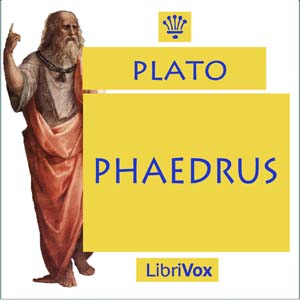
Phaedrus
by Plato (428/427 BC - 348/347 BC)
Translated by Benjamin Jowett (1817-1893)
“For there is no light of justice or temperance, or any of the higher ideas which are precious to souls, in the earthly copies of them: they are seen through a glass, dimly…”
Socrates and his earnest friend Phaedrus, enjoying the Athenian equivalent of a lunchtime stroll in the park, exchange views on love and on the power of words, spoken and written.
Phaedrus is the most enchanting of Plato’s Erotic dialogues (capitalised in honour of the god). The barefoot philosopher urges an eager young acquaintance – who has allowed his lover’s oratorical skills to impress him overmuch – to re-examine the text of Lysias’s speech in the light of his own exalted (and Platonic) vision of Love.
Not long ago this early example of literary dismantling was itself deconstructed by a contemporary sage - Jacques Derrida.
The present reader tries to present Socrates as he conceivably was: the chortling, pot-bellied ex-soldier, a flirtatious yet charismatic talker with a serious passion for Truth. (Introduction by Martin Geeson)
- Gutenberg e-text
- Wikipedia - Plato
- Wikipedia - Phaedrus
- Wikipedia - Benjamin Jowett
- M4B audiobook of Complete Book
- LibriVox’s Phaedrus Internet Archive page
- Zip file of the entire book 102.5MB
- RSS feed · Subscribe in iTunes
Total running time: 3:33:31
Read by Martin Geeson
In addition to the reader, this audio book was produced by:
Dedicated Proof-Listener: Betty M.
Meta-Coordinator/Cataloging: Philippa
mp3 and ogg files
- 01 - "My dear Phaedrus, whence come you..." – 00:13:29
[mp3@64kbps - 6.4MB]
[mp3@128kbps - 12.9MB]
[ogg vorbis - 8.19MB] - 02 - "What an incomprehensible being you are..." – 00:14:55
[mp3@64kbps - 7.1MB]
[mp3@128kbps - 14.3MB]
[ogg vorbis - 9.02MB] - 03 - "Now, Socrates, what do you think?" – 00:16:15
[mp3@64kbps - 7.8MB]
[mp3@128kbps - 15.6MB]
[ogg vorbis - 9.82MB] - 04 - "And now, dear Phaedrus, I shall pause..." – 00:15:36
[mp3@64kbps - 7.4MB]
[mp3@128kbps - 14.9MB]
[ogg vorbis - 9.50MB] - 05 - "Your love of discourse, Phaedrus, is superhuman..." – 00:13:34
[mp3@64kbps - 6.5MB]
[mp3@128kbps - 13.0MB]
[ogg vorbis - 8.28MB] - 06 - "I might tell of many other noble deeds..." – 00:19:18
[mp3@64kbps - 9.2MB]
[mp3@128kbps - 18.5MB]
[ogg vorbis - 12MB] - 07 - "Thus far I have been speaking..." – 00:23:06
[mp3@64kbps - 11.0MB]
[mp3@128kbps - 22.1MB]
[ogg vorbis - 14MB] - 08 - "And so the beloved, who, like a god..." – 00:19:14
[mp3@64kbps - 9.2MB]
[mp3@128kbps - 18.4MB]
[ogg vorbis - 12MB] - 09 - "Shall we discuss the rules of writing...?" – 00:12:09
[mp3@64kbps - 5.8MB]
[mp3@128kbps - 11.6MB]
[ogg vorbis - 7.44MB] - 10 - "Suppose that you read me the first words..." – 00:18:36
[mp3@64kbps - 8.9MB]
[mp3@128kbps - 17.8MB]
[ogg vorbis - 11MB] - 11 - "Leave the unimportant..." – 00:13:38
[mp3@64kbps - 6.5MB]
[mp3@128kbps - 13.1MB]
[ogg vorbis - 8.39MB] - 12 - "Oratory is the art of enchanting the soul..." – 00:10:55
[mp3@64kbps - 5.2MB]
[mp3@128kbps - 10.4MB]
[ogg vorbis - 6.66MB] - 13 - "Enough appears to have been said..." – 00:11:49
[mp3@64kbps - 5.6MB]
[mp3@128kbps - 11.3MB]
[ogg vorbis - 7.24MB] - 14 - "And now, Phaedrus, having agreed..." – 00:10:57
[mp3@64kbps - 5.2MB]
[mp3@128kbps - 10.5MB]
[ogg vorbis - 6.66MB]
Cataloged on May 08, 2010


